


absurd

Vesna Božić · Independent

Research platforms · Internal tools · AI & RAG

Built to stand.Built to be used.

Software engineer & sociologist. I build research platforms, business tools and AI.

I’m Vesna Božić, a software engineer and a sociologist.

I design and build research platforms, internal tools and AI automation for research and business teams—from product decisions to launch.

Serbia · CET/CEST · Remote

Selected work · floors 01–03

Ideas, made real.

Three projects, from accessible research to connected business tools and searchable archives.

A brutalist megastructure: solid concrete volumes on the left dissolve into an open scaffold of cubes on the right, with small figures on the terraces
Film still: the start of the climb.
Still 1The foot of the climb.

Case study · Research platform

Istražimo.

A research platform for designing studies, collecting responses and analysing results.

In useCurrently supporting a live study with deaf participants.
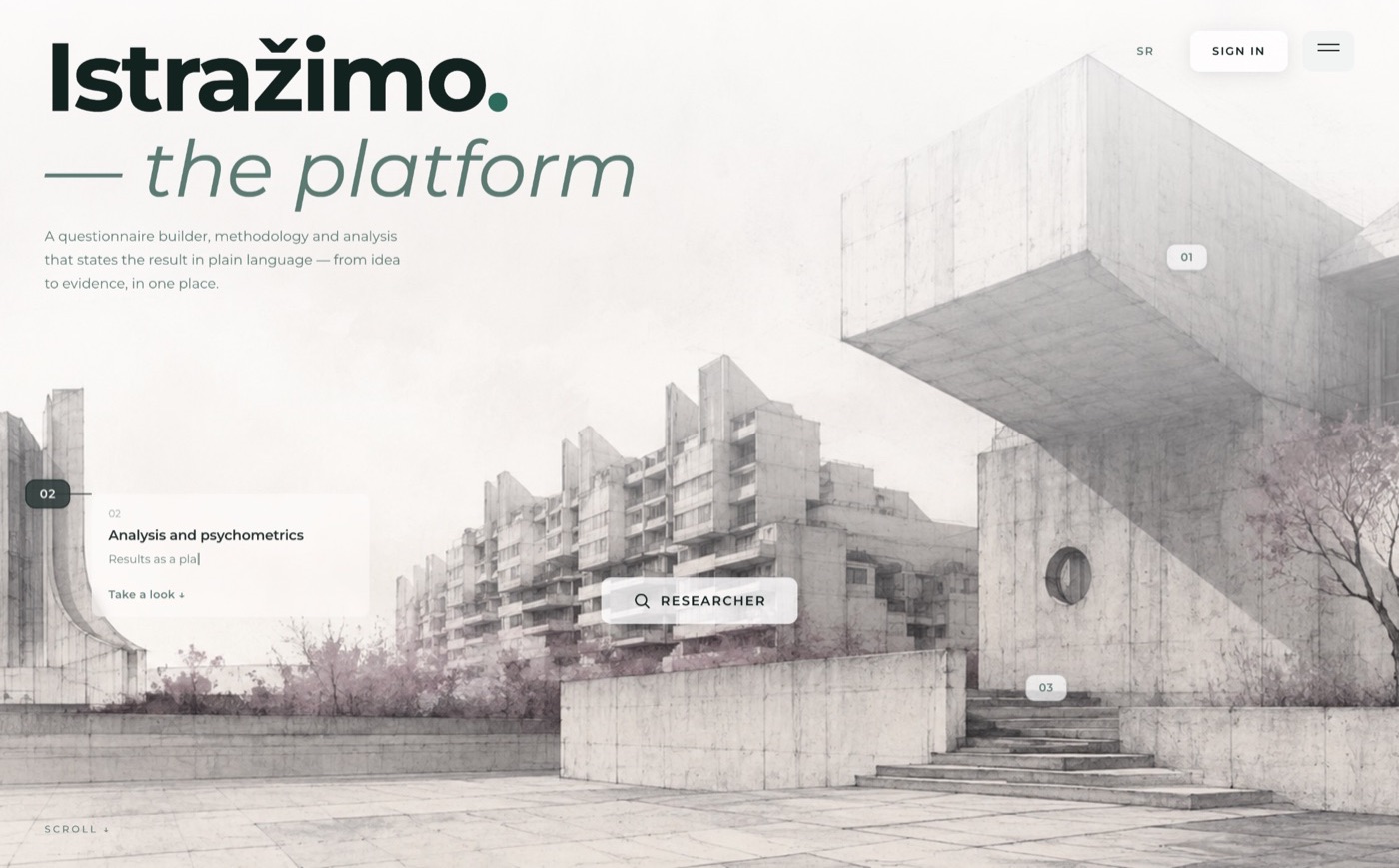
Istražimo public landing page with concrete architecture and an introduction to the research platform
Study designQuestions
+ logic.
ParticipationConsent
+ responses.
AnalysisResults
+ export.
Public landing page, September 2026. The platform supports sign-language video in survey questions.
The problem

From study design to participation.

I built study design, consent, participation and analysis into one workflow, with support for sign-language videos. Published question versions keep answers connected to their original context.

The key decision

Tie each response to a published instrument version, and keep that link through the main results and export workflow.

  1. Integrity

    Saves in sequence.

  2. Responsibility

    Access with boundaries.

  3. Interpretation

    Statistics in context.

Engineering notes
Integrity — Saves in sequence.

Queued saves and stale-update rejection protect newer answers. Shared branching rules remove answers outside the current path; completion waits for server confirmation.

Responsibility — Access with boundaries.

Study editing, aggregate analysis and raw responses have separate permissions. Participants give explicit consent; researchers retain control over collaboration.

Interpretation — Statistics in context.

Descriptive statistics, Welch’s t-test, Cohen’s d and Cronbach’s alpha support analysis. Reliability includes item selection and sample limitations; it does not establish construct validity.
Scope
Product · Interface · API · Statistics · Infrastructure
Built with
Next.js · TypeScript · Hono · DynamoDB · AWS
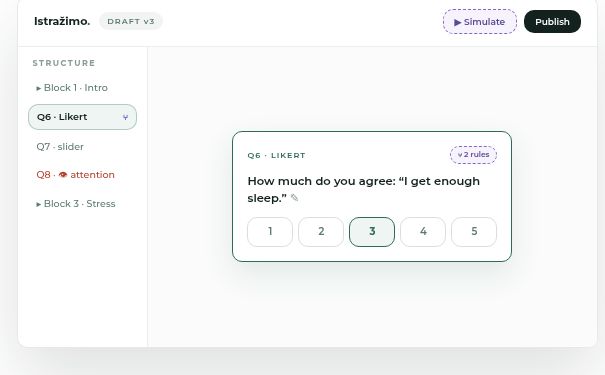
Istražimo questionnaire builder: questions, options and branching logic
Builder · questions, options and logic
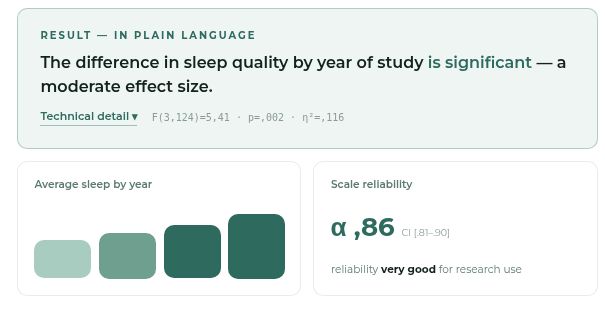
Istražimo analysis view with results in plain language
Analysis · results in context

Also built: scales, matrices, ranking, uploads, invitations, question-level comments, bilingual workflows, CSV/codebooks and SPSS import syntax. Panel and pilot features have rollout restrictions.


Case study · Platform engineering

Transform.

Connected tools for consulting teams: research studies, coaching programmes and recruitment.

Built across the suiteSurvey-to-report workflows, coaching operations and AI-assisted recruitment.

Workflow diagram · Transform
Shared workspace Identity · access · navigation
  • ResearchSurveys to
    reports
  • CoachingMatching, sessions
    and feedback
  • RecruitmentCV intake to
    screening
Shared UIAWS servicesIndependent releases
Selected workflows connected through shared access and infrastructure. Implementation spans development and staging.
The problem

One workspace. Different kinds of work.

Consulting teams move between studies, coaching programmes and recruitment. I built the shared workspace and application workflows, with common access rules and room for each product to develop independently.

The key decision

Centralize identity and access rules, while integrated applications create their own sessions and retain independent release paths.

  1. Authorization

    A session is not a grant.

  2. Consistency

    Rules with one source.

  3. History

    Records that stay true.

Engineering notes
Authorization — A session is not a grant.

In the training application, the API checks current central access grants on subsequent requests. Shared sign-on uses a short-lived, single-use ticket. The receiving backend creates an HttpOnly cookie session; the central identity token stays out of the handoff.

Consistency — Rules with one source.

A central registry generates shared configuration. A common permission matrix informs interface and API decisions, with consistency checks in delivery workflows.

History — Records that stay true.

Training enrollments snapshot the original course details. A transactional check verifies the course at write time, so later catalog edits cannot silently rewrite history.

Scope
Architecture · Applications · Identity · Cloud delivery
Built with
TypeScript · Python · AWS · Infrastructure as code

Also built: reusable UI, permission audit trails, asynchronous notifications, infrastructure and delivery checks, knowledge ingestion and configuration-controlled AI features. Implementation spans development and staging; some integrations retain older patterns.

Film still: a third of the way up the climb.
Still 2A third of the way up.

Case study · Document intelligence

Catalog Star.

Search scanned auction catalogues by text or image, with results linked to the original catalogue page.

Scale & quality3.5M+ auction lots · >97% precision8M+ text and image records combined

Workflow diagram · Catalog Star
  1. Scanned catalogue

    Original pages, text and photographs

  2. Extraction & image matching

    Connect each entry to its evidence

  3. Text & image search

    Find entries by words or visual similarity

  4. Back to the original page

    Inspect the source behind the result

Document · page · entry
Source references stay with each result.
Workflow diagram. Extraction is checked against the source; publication to search is verified separately.
The problem

Find the object. Check the source.

Scanned catalogues make it hard to find and compare objects across an archive. I built extraction, image matching, search and review tools so each result can be checked against its original page.

The key decision

Treat model output as a proposal. Verify it against page evidence, then verify publication to search as a separate operation.

  1. Uncertainty

    Keep the reason.

  2. Provenance

    Keep the source.

  3. Publication

    Verify the release.

Engineering notes
Uncertainty — Keep the reason.

Unresolved records retain a status and explanation. A text page that still fails after retries blocks completion. Human review is targeted; a review status does not mean someone has already checked it.

Provenance — Keep the source.

Caption positions and page text connect images to entries, with vision confirmation where needed. Results retain document, page and segment references; corrections preserve an audit trail.

Publication — Verify the release.

Index changes begin with a read-only plan, then capped writes and per-record verification. Versioned releases, health checks and automatic rollback protect the searchable collection.

Scope
OCR · Extraction · Image linking · Search · Review tools
Built with
Python · React · Cloud processing · Vector search

Also built: document triage, cached text vectors, image embeddings, full-text and combined search, correction tools and an index membership registry. Accepted extraction and published search results remain distinct states.

Services

Make it work. Make it stick.

Infrastructure and models on one side. People, incentives and trust on the other. I work across the seam.

Engineering.

Systems that run, with clear specifications, measured quality and costs that follow volume.

  1. AI systems & integrationClaude · OpenAI · Gemini, in real workflows
  2. RAG & knowledge searchAnswers grounded in your documents, with source references
  3. Agents & automationFrom n8n prototype to production
  4. Serverless platformsAWS · CDK · Bedrock · CI/CD
  5. Web apps & design systemsReact · Next.js, end to end

Organization.

Systems people can use, trust and keep working with after the handover.

  1. Adoption & incentivesWho uses it, and why they would
  2. Workflow researchThe real process and the documented one
  3. Trust, GDPR & auditAccountability within the workflow
  4. Handover & trainingDocumentation, ownership and continuity
  5. First-feature strategyA focused starting point for an AI product
Film still: past halfway up the climb.
Still 3Past halfway.

Method

A clear path through.

  1. Diagnose

    Understand the problem and the people doing the work.

  2. Specify

    Agree on the workflow, boundaries and success criteria.

  3. Build

    Implement, evaluate and test in the real workflow.

  4. Hand over

    Leave a system that is documented, measured and yours.

About

Engineer. Sociologist.

I'm Vesna Božić. Years spent reading organizations before building for them — now both, at once. Independent practice.

Practice
Independent · remote-first
Based in
Serbia · CET/CEST
Stack
Python · TypeScript · AWS
Tools
Claude Code · n8n · CDK
Languages
SR · EN · ES · IT

Contact

Topping out.

When the structure is complete, builders put a small tree on the roof. Then the people move in.

Start with three sentences.

What are you building, who is it for, and where are you stuck? A real reply within two working days.

  1. What are you building?
  2. Who is it for?
  3. Where are you stuck?

The next floor is yours.

vesna.bozic.se@gmail.com

Serbia · CET/CEST · Independent · Remote

Film still: the summit.
Still 4The summit.